06 June 2026
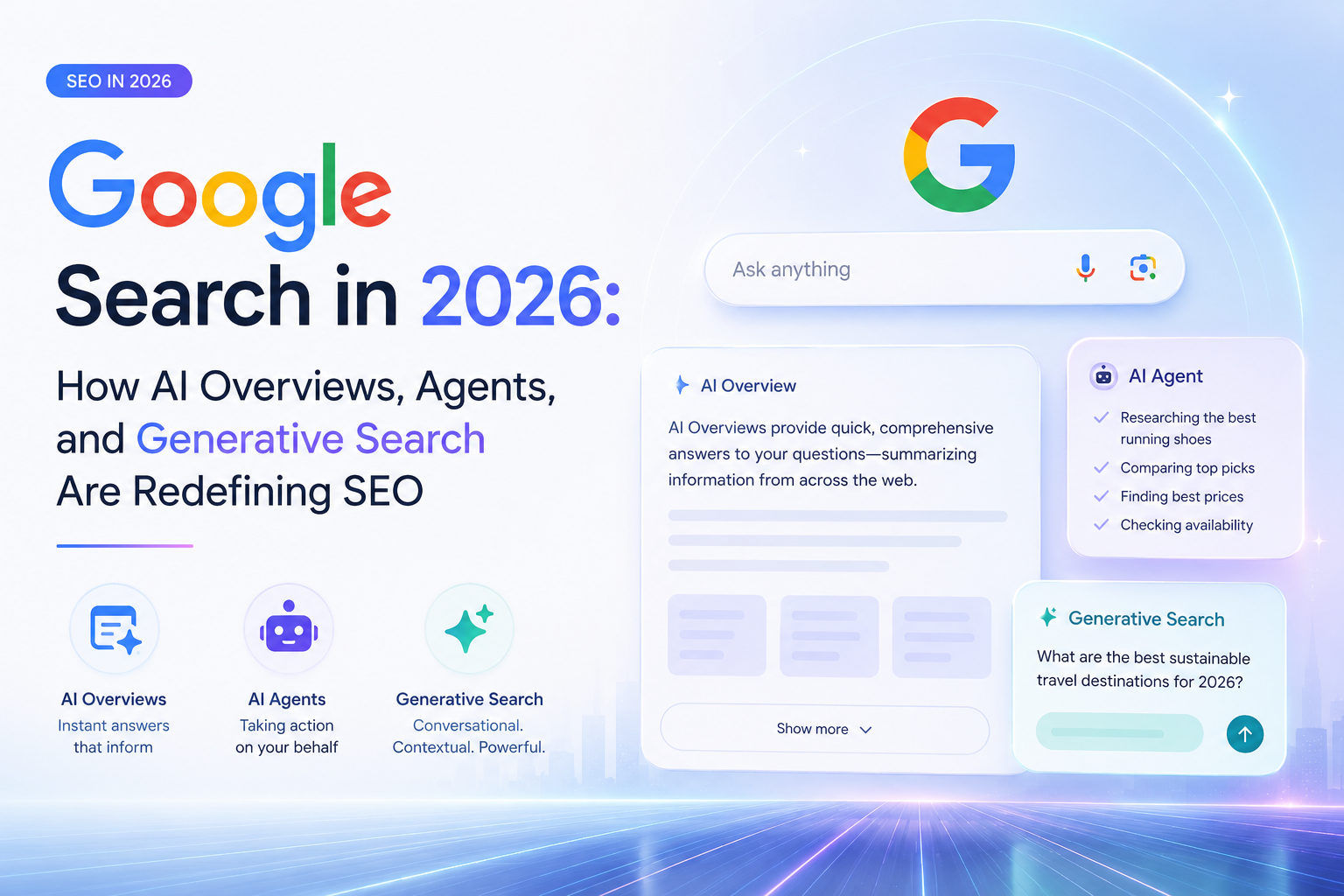
Google Search in 2026: How AI Overviews, Agents, and Generative Search Are Redefining SEO
A few years ago, searching for information online was a very different experience. Whenever we wanted to learn about a topic, we would often open multiple tabs in Google Search and visit several websites. Even though we were looking for the same information, we would read different articles, compare sources, and try to piece together the answer ourselves.
This process often took time and sometimes created confusion, especially when different websites provided different explanations or viewpoints. As a result, users had to spend considerable time browsing through multiple pages before finding the information they needed.
Today, the experience has changed dramatically. Thanks to advances in artificial intelligence and AI-powered search systems, finding information has become faster, smarter, and more direct. Modern search engines now understand user intent more deeply, analyze multiple sources, and generate summarized answers within seconds.
Instead of opening dozens of tabs and manually comparing websites, users can now get relevant answers almost instantly. This shift is largely driven by technologies like Google AI Overviews, generative search, and AI agents that are reshaping how information is delivered online.
This article explains five major innovations that are transforming search and SEO in 2026:
- AI Overviews in search results
- AI agents capable of performing real-world tasks
- Generative Engine Optimization (GEO) vs traditional SEO
- Zero-click searches and traffic shifts
1. AI Overviews in Search Results
We are now living in a search ecosystem where Artificial Intelligence is deeply integrated into everyday browsing behavior. Traditional Google Search, where users clicked multiple links to find answers, is gradually being replaced by AI-generated summaries.
This shift is part of Google’s broader move toward AI Overviews and Search Generative Experience (SGE), where users receive direct answers without needing to visit multiple websites.
In this new model:
- AI provides direct answers to user queries
- Information is summarized from multiple trusted sources
- Users spend less time clicking individual pages
Instead of exploring 10 different websites, users now often see a complete answer directly on the search page.
By 2026, this behavior has become mainstream. Whether you are a blogger, SEO expert, or content creator, you will notice a clear rise in zero-click searches where users never leave Google.
In simple terms, AI Overviews are changing search from a “link-based system” into an “answer-based system.”
2. AI Agents: Search That Thinks and Acts
Another major shift is the rise of AI agents in search systems. Unlike traditional search engines that only show information, AI agents can now perform actions on behalf of the user.
For example, if you search for “best places to visit in Turkey,” modern AI systems don’t just show travel blogs they can actively help you plan your trip.
AI agents can:
- Plan complete travel itineraries
- Compare flights, hotels, and prices
- Summarize research automatically
- Handle multi-step workflows
For instance, planning a one-week trip to Turkey could look like this:
- Generate a full itinerary
- Suggest flights based on budget
- Recommend hotels and locations
- Compare booking options in real time
This represents a major shift from search engines to execution-based systems.
The key change is simple but powerful: websites are no longer competing only for clicks—they are competing to become part of AI-driven workflows and recommendations.
3. Generative Engine Optimization (GEO) vs SEO
Search Engine Optimization (SEO) has always been the foundation of digital visibility. For years, websites have focused on ranking through keywords, backlinks, and technical optimization.
Traditional SEO focuses on:
- Keywords and search intent
- Backlinks and authority signals
- Meta tags and on-page optimization
- Search engine rankings
However, in 2026, a new layer has emerged: Generative Engine Optimization (GEO).
GEO focuses on optimizing content for AI systems rather than only search engines. The goal is not just ranking, but becoming part of AI-generated answers.
GEO ensures content is:
- Easily understood by AI models
- Trusted as a reliable source
- Selected for AI-generated responses
Instead of only appearing in search results, content now needs to appear inside AI Overviews, chat-based search, and generative responses.
“Don’t worry, SEO is not being replaced by GEO. It is simply evolving how ranking works. SEO helps you rank, while GEO helps you get included in AI-generated answers.”
SEO vs GEO
SEO (Traditional)
- Rank in search results (blue links)
- Keyword-focused optimization with tools like Ahrefs and SEMrush
- Backlinks as key ranking factor
- Traffic from clicks
- Focus on web pages
GEO (2026 Evolution)
- Be cited in AI-generated answers
- Contextual + semantic optimization
- Authority + trust + brand mentions
- Visibility inside AI responses
- Focus on entities and structured knowledge
4. Zero-Click Searches: The Silent Traffic Shift
In 2026, one of the biggest changes in search behavior is the rise of zero-click searches, where users get answers directly without visiting websites.
For example, if someone searches:
“What is Agentic AI?”
Instead of clicking on a blog, they may immediately see:
- AI-generated explanation
- Key summarized points
- Related follow-up suggestions
Impact of Zero-Click Searches:
- Many informational blogs lose direct traffic
- News websites see reduced page visits
- Affiliate and review sites face higher competition
However, this does NOT mean websites are becoming irrelevant.
Instead, their role is changing.
Websites are now becoming trusted data sources for AI systems, rather than just final destinations for users.
At the same time, strong brands and authoritative websites gain a new advantage: visibility inside AI-generated answers even without clicks.
New Blog
Google Introduces a New Generation of AI Development Tools at Google I/O 2026
Conclusion
The evolution of Google Search in 2026 clearly shows one direction: search is shifting from “finding websites” to “getting instant answers and completing tasks.”
AI Overviews, AI agents, GEO, and zero-click searches are not just trends—they represent a complete transformation of how digital information flows.
For content creators, bloggers, and SEO professionals, this shift brings both challenge and opportunity. Those who adapt to AI-driven search systems will grow, while those relying only on traditional SEO may fall behind.
In my opinion, the future of search is no longer just about ranking on Google—it is about becoming part of AI systems that deliver answers directly to users.
The websites that survive this transformation will be those that focus on clarity, authority, structured information, and AI-friendly content ecosystems.
Key Questions About GEO and AI Search in 2026
1. What is GEO in SEO 2026?
GEO (Generative Engine Optimization) is the process of optimizing content so AI systems can understand, trust, and include it in AI-generated responses like Google AI Overviews.
2. How do AI Overviews affect organic traffic?
AI Overviews reduce direct clicks because users often get answers instantly, but high-quality and authoritative content can still gain visibility inside AI responses.
3. Is GEO replacing traditional SEO?
No. GEO extends SEO rather than replacing it. SEO remains the foundation, while GEO focuses on AI visibility.
4. How to rank in AI search results?
Content should be clear, structured, fact-based, and aligned with E-E-A-T principles, with strong authority signals and semantic relevance.
About the Author
Muhammad Shafeeq