24 May 2026
Java Developer Roadmap 2026: Complete Guide to Learn Java from Beginner to Advanced
JAVA Developer Roadmap 2026 (Complete Guide)
My name is Muhammad Latif, and I have been teaching Java for the last five years. During this journey, I have uploaded more than 300 videos and guided thousands of students in learning programming and software development.
When I first started learning Java, I had no idea where to begin. There were too many technologies, frameworks, and tutorials available online, which made the learning process confusing.
Now in 2026, the world of programming has changed completely. AI tools have become extremely powerful, and learning software development is faster than ever before. But even today, one important question remains the same:
What is the best roadmap to learn Java in 2026?
In this article, I am sharing a complete Java Developer Roadmap based on my teaching experience and real industry knowledge.
Whether you are:
- A complete beginner
- A college student
- A self-taught learner
- A developer switching to Java
This guide will help you learn Java step by step in the right direction.
YouTube video for Java Developer Roadmap
STEP 1: JAVA JDK & JVM (Foundation)
Many beginners make a common mistake: they start coding directly without understanding how Java actually works.
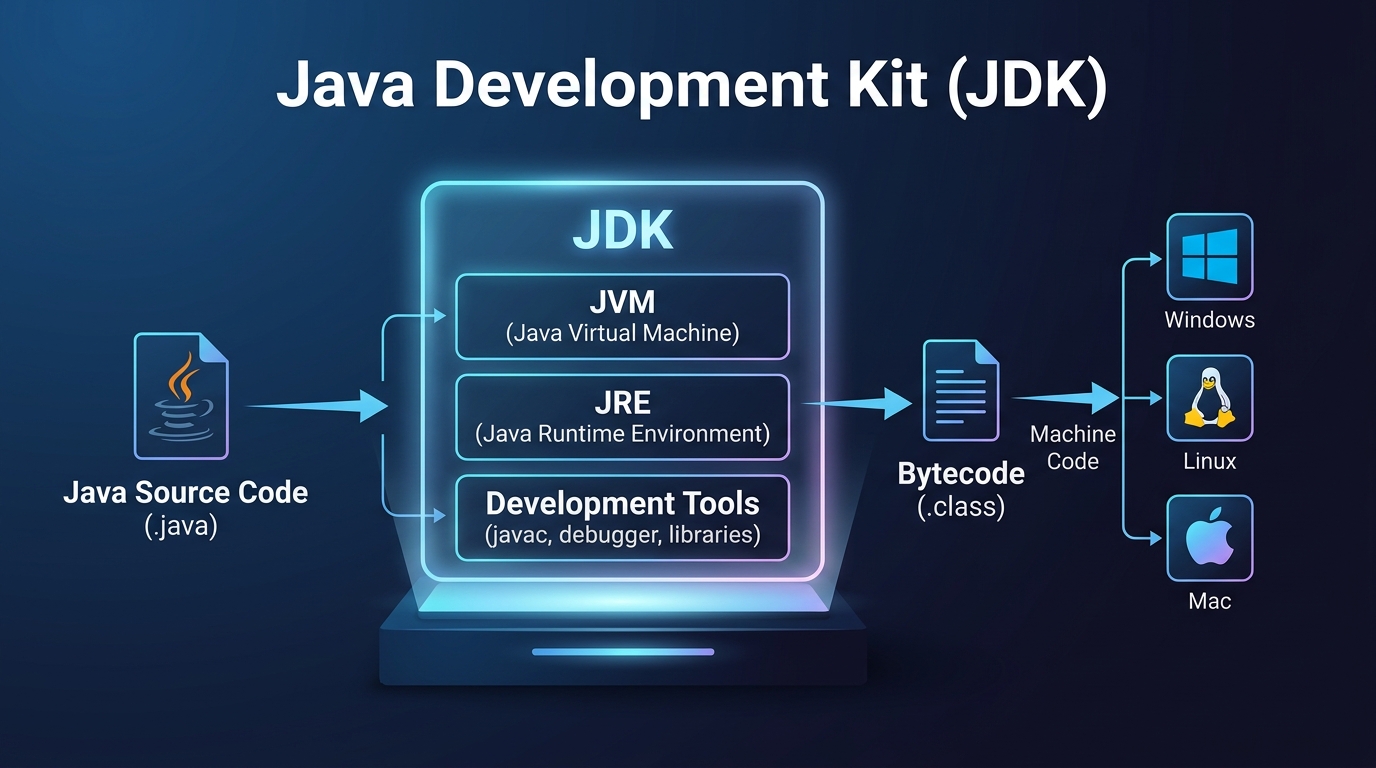
Before writing code, you must understand JDK (Java Development Kit).
JDK helps you understand how Java executes programs internally.
Inside JDK, the most important component is JVM (Java Virtual Machine).
JVM explains:
- How Java source code is converted into bytecode
- How bytecode is converted into machine code
- Why Java is platform independent
This foundation makes your Java learning journey strong and professional.
STEP 2: JAVA BASICS
After understanding JDK and JVM, you move to Java basics where real coding begins.
Variables and Data Types
Variables store data, while data types define what kind of data is stored.
Primitive Data Types:
- int
- float
- char
- boolean
- double
Non-Primitive Data Types:
- String
- Arrays
- Objects
Understanding memory usage and data behavior is very important in Java.
Control Flow (Loops)
Loops are used to repeat tasks in Java.
Types of loops:
- for loop
- while loop
- do-while loop
- for-each loop
Loops help reduce repetition and improve logic building.
If-Else and Switch
Conditional statements control program decision-making.
- if-else → used for complex conditions
- switch → used for multiple fixed choices
These are essential for real-world logic building.
Functions (Methods)
Functions are reusable blocks of code.
You must learn:
- Method creation
- Return types
- Parameters
- Method calling
Functions make code clean and reusable.
Arrays and Strings
- Arrays store multiple values in one variable
- Strings handle text data
Both are widely used in real applications and problem solving.
CORE JAVA
Core Java is the most important stage in Java learning.
OOP (Object-Oriented Programming)
Java is fully based on OOP concepts.
Class and Object
- Creating classes
- Creating objects
- Object interaction
Constructors
- Default constructor
- Parameterized constructor
- Constructor overloading
Four Pillars of OOP in Java
Encapsulation
Binding data and methods together with controlled access.
Inheritance
One class inherits properties of another class.
Polymorphism
Same method behaves differently (overloading & overriding).
Abstraction
Hiding implementation and showing only essential features.
Interfaces & Access Modifiers
Interface
A blueprint of a class used for abstraction.
Access Modifiers:
- public
- private
- protected
- default
Exception Handling
Used to handle runtime errors:
- try
- catch
- finally
- throw
- throws
Prevents program crashes.
File Handling
Used for data storage and file operations:
- Create file
- Write file
- Read file
- Delete file
Java Collections Framework
Used to manage groups of data efficiently.
List
Ordered collection allowing duplicates.
ArrayList
Dynamic array structure.
LinkedList
Fast insertion and deletion using nodes.
Set / HashSet
Stores unique values only.
Map
Key-value data structure for fast lookup.
“Complete Java Mastery Course (Beginner to Advanced)”
JAVA DEVELOPMENT
After Core Java, you move to backend development.
Servlets
Servlets help you understand how Java web applications work internally.
Even if not used directly today, Servlets teach:
- Request handling
- Response generation
- Server-side working
This builds strong backend fundamentals.
Spring Boot
Spring Boot is the most powerful Java framework today.
It simplifies backend development.
Spring Boot Modules
Spring Boot Data JPA
Handles database operations easily.
Spring Boot Security
Used for authentication and authorization.
Spring Boot AI
Modern integration for AI-based applications.
Why Spring Boot is Important
Spring Boot is:
- Fast
- Scalable
- Secure
- Industry standard
CONCLUSION
Becoming a Java developer is not about rushing topics. It is about following a proper roadmap step by step.
If you follow this path:
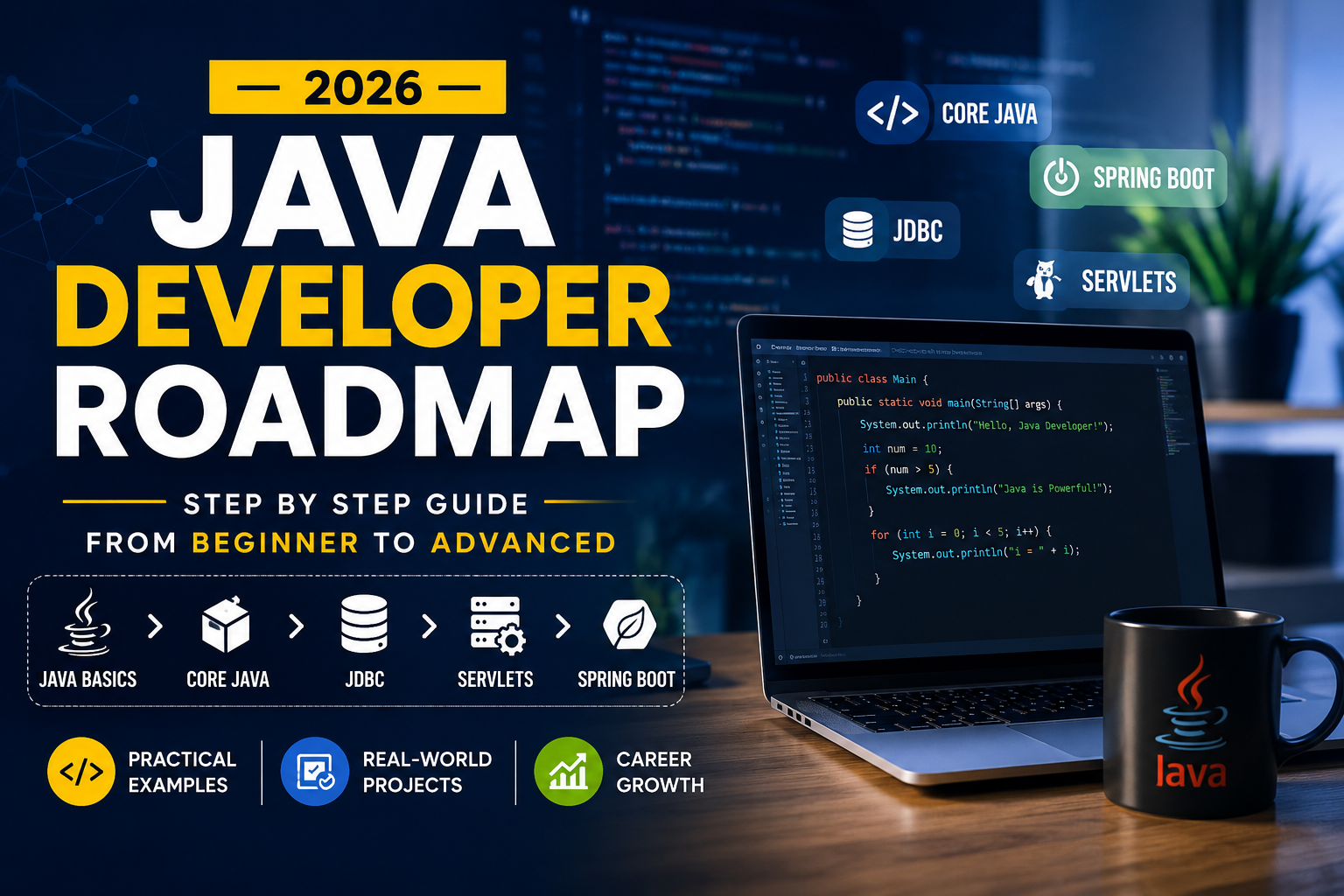
Java Basics → Core Java → JDBC → Servlets → Spring Boot
You will become a strong backend developer. (Java full stack developer complete course)
Each stage builds your skills:
- Core Java builds logic
- JDBC connects database
- Servlets explain backend flow
- Spring Boot builds real applications
In today’s AI era, Java is still one of the most stable and in-demand languages. Success depends on consistency, practice, and real project building.